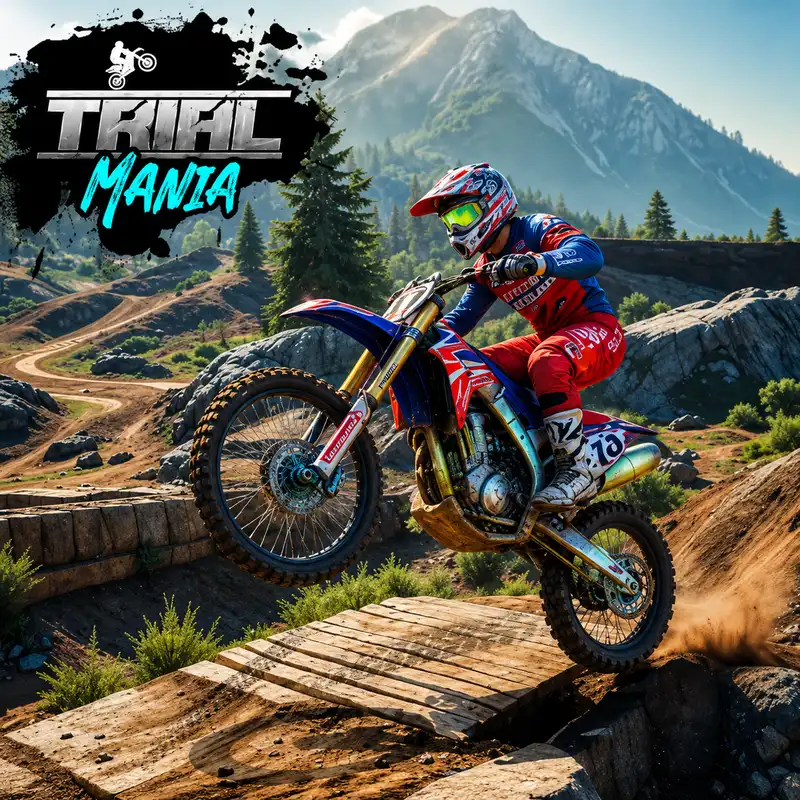













Here's the rule in Trial Mania that nobody states plainly:
You don't fail when the bike falls over. You fail when your rider's head touches the ground.
That's a trials-game mechanic, and it changes everything. You can land badly, wobble, bounce, come down at an ugly angle and keep going — as long as you stay on the bike. Which means the goal isn't a perfect landing. It's keeping your rider upright.
There's also one lean rule that fixes most crashes, and it's the opposite direction in two different situations. Here's the full guide.
What Is Trial Mania?
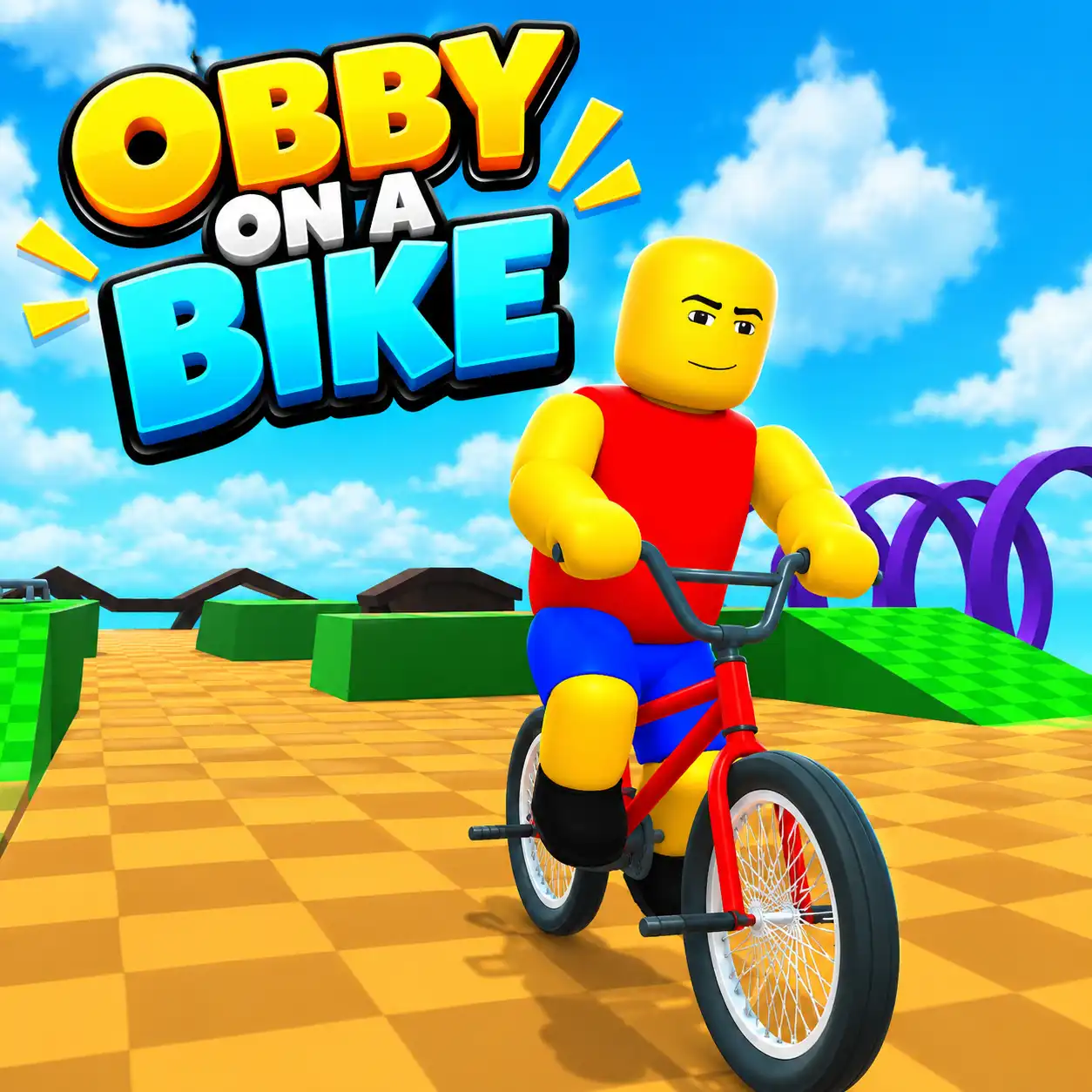
Trial Mania is a free 3D dirt bike trials game by HikBoo Studios, released in November 2024. It runs on WebGL in your browser with no download, on desktop and mobile.
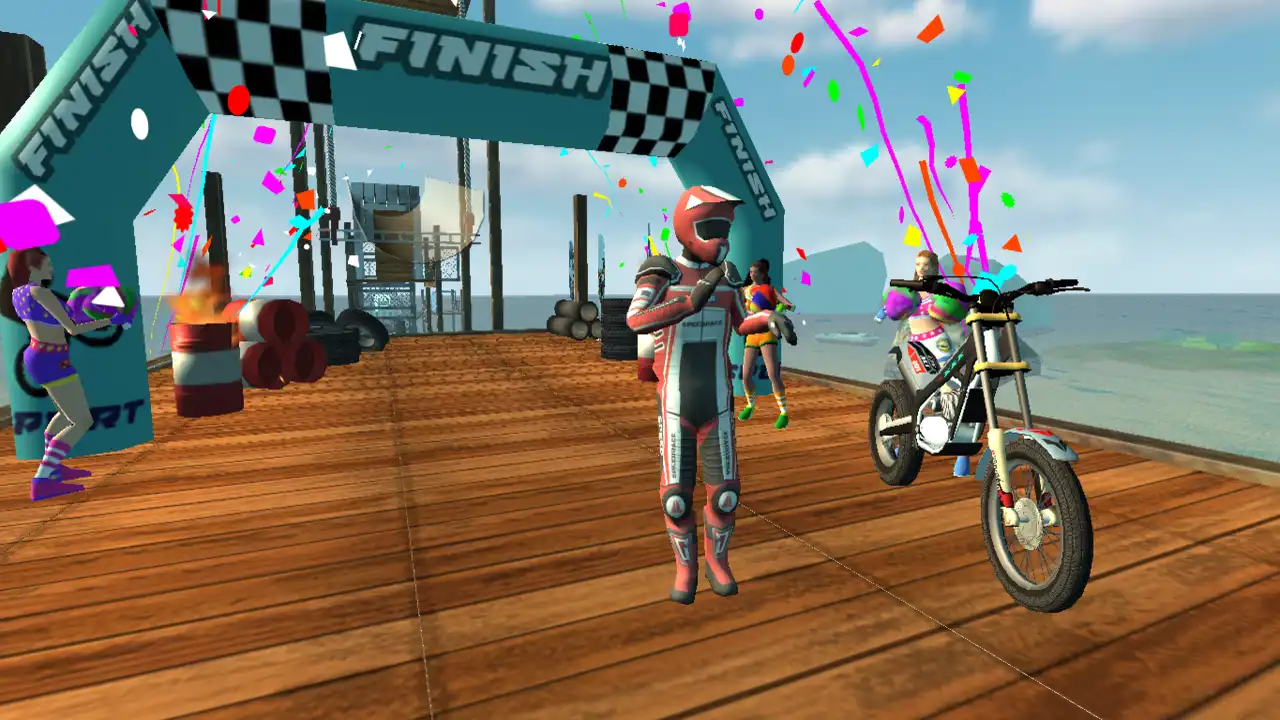
You ride across narrow planks suspended above the sea, threading through transparent tubes, over steep ramps, past fires and rolling balls. Fall off the planks and you're in the water.
There are over 100 levels spread across four environments, three difficulty settings, and a garage of upgradeable bikes.
It's single-player — you're racing the course and your own previous times, not other riders.
Controls
Action | Key |
Accelerate | W or Up arrow |
Brake | S or Down arrow |
Lean back (backflips) | A or Left arrow |
Lean forward (front flips) | D or Right arrow |
Four inputs. On mobile, it's on-screen touch controls — throttle and brake on one side, lean buttons on the other.
A and D don't steer. They tilt your rider's body, which does two jobs: adjusting your bike's angle in the air, and shifting your weight on the ground.
The One Lean Rule That Fixes Everything
This is the technique. Learn it and most of your crashes disappear.
Lean FORWARD when climbing steep hills. Going uphill, your front wheel wants to lift. Shifting weight forward keeps it planted so you actually climb instead of looping over backwards.
Lean BACK when landing after a jump. Coming down, your nose wants to drop. Shifting weight back levels the bike so you land on both wheels rather than pitching over the bars.
Uphill: forward. Landing: back.
It sounds simple written down, but under pressure most players do neither — or worse, hold one lean the whole time. Small taps, in the right direction, at the right moment.
Speed Is the Other Half
The second thing that decides your runs.
Don't floor it from the start. Full throttle out of the gate means arriving at the first ramp too fast to control. Ease into it.
Every ramp has a correct speed. Too slow and you come up short. Too fast and you sail clean over the landing — which is just as fatal when the landing is a narrow plank above the sea. You find the right speed by failing a couple of times, not by holding W harder.
Slow down for narrow sections. Speed helps you clear gaps. It actively hurts you on tight plank work, where precision matters more than momentum.
Brake before jumps you need to shorten. If the landing platform is close, ease off before the ramp rather than trying to correct mid-air.
Flips: When and When Not
Leaning far enough in the air produces front flips and backflips.
Use them on big ramps where you can see the landing. There's time to complete the rotation and still level out before touchdown.
Don't flip on small jumps. If you're still rotating when you hit the ground, your rider goes down and the run ends.
Flips also double as corrections. If you've left a ramp at a bad angle, the lean keys are how you fix it — the same input that produces a flip also produces a small adjustment. Most of your leaning in the air should be corrections, not tricks.
Checkpoints Save You
When you fault, you restart from the last checkpoint rather than the beginning of the level.
That's more forgiving than it looks, and it should change how you play. A mistake deep into a long course costs you seconds, not the whole run.
Practical implication: take the risky line. Since a fault only sends you back a short way, attempting the faster or more spectacular route is usually worth it. Playing ultra-safe for four minutes to avoid a two-second setback is a bad trade.
The Four Worlds
Over 100 levels spread across four environments:
Seaside — Planks above open water. The starting environment, and where you learn the basics.
Snowy slopes — Icy conditions where grip is at its lowest.
Desert safari — Open, sandy terrain with different momentum behaviour.
Forest trails — Tighter, more technical routes.
Each environment changes how your bike behaves, so a setup and a riding style that works on seaside planks won't transfer directly to snow. Expect to relearn the feel when you move to a new world.
Three Difficulty Levels
Noob — The gentlest setting. Start here to learn the lean rule without constant restarts.
Rider — The middle ground, and where most players settle.
Pro — Tightest tolerances and least forgiveness.
Don't jump to Pro early. The lean-and-throttle instincts have to be automatic before the harder settings become fun rather than frustrating. Clear a chunk of levels on Noob, move to Rider, and only then think about Pro.
Upgrades: Speed, Grip and Agility
Coins earned from completing levels buy three upgrades:
Upgrade | What it does |
Speed | Acceleration and top pace |
Grip | Traction on ramps, climbs and landings |
Agility | How quickly the bike responds to your lean inputs |
Buy grip first. Most failed runs come from a wheel losing traction on a climb or a landing going sideways. Grip fixes both, and it's especially valuable once you reach the snowy levels.
Agility second. Since leaning is your main control, a bike that responds faster to A and D gives you more margin to correct a bad launch.
Speed last. You already have enough pace to clear most gaps — the problem is usually control, not power. Buying speed early just means arriving at obstacles faster than you can handle them.
Tips That Actually Help
Lean forward uphill, lean back on landings. The single most useful rule in the game.
Tap the lean keys — don't hold them. Long holds over-rotate. Short taps adjust.
Ease into the throttle. Full speed from the start line is how the first ramp beats you.
Find each ramp's correct speed. It's usually less than you think.
Flip only on big air. Small jumps don't give you room to finish the rotation.
Take the risky line. Checkpoints mean a fault costs seconds, not minutes.
Relearn the feel in each new world. Snow, sand and forest all behave differently.
Common Problems
I loop over backwards on hills. Lean forward (D) while climbing to keep the front wheel down.
I land on my face after jumps. Lean back (A) as you come down to level the bike out.
I clear the ramp but overshoot the landing. Too much speed. Brake before the ramp so you launch shorter.
I fall short of gaps. Not enough run-up. Build speed on the flat before the ramp, not on it.
My flips end in a crash. You're attempting them on small jumps. Save them for big air.
I keep falling in the sea. You're carrying too much speed through narrow plank sections. Slow down where it's tight.
The snow levels feel impossible. Grip is lowest there. Upgrade grip before pushing into those worlds.
Keyboard doesn't respond. Click once directly on the game window first. Browser games need focus before they register keystrokes.
Frequently asked questions
Is Trial Mania free
Yes — free in your browser, no download and no account needed.
Who made it, and when?
HikBoo Studios, released November 2024.
How many levels are there?
Over 100, across seaside, snowy, desert and forest environments.
What are the controls?
W or Up to accelerate, S or Down to brake, A or Left to lean back, D or Right to lean forward.
What counts as a crash?
Your rider's head touching the ground. The bike wobbling or landing awkwardly is fine as long as you stay on.
Are there checkpoints?
Yes — a fault restarts you from the last checkpoint, not the start of the level.